

Why I love watching A Clockwork Orange.
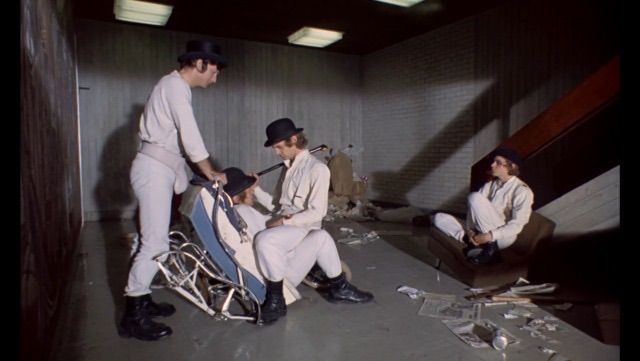
Out of all the films I've seen thus far in my life, there are very few movies that have fascinated me as much as the 1971 Kubrick film A Clockwork Orange, based on the 1962 Anthony Burgess novel of the same name. Unsurprisingly, the mention of A Clockwork Orange in conversation provokes intensely polarized responses. From the immediate reconnection with distant relatives, to the resigned "I couldn't get past the first few minutes...". The film was banned in several countries, and even taken out of screening by Kubrick himself, only ever being shown in England again in 1999, after Kubrick's passing. This wasn't without any basis, however. The film contains multiple scenes full of Rape, murder, torture and nearly any other kind of reprehensible act one human could do to another. This is often chocked up to "shock value." simplifying the inclusion of the scenes to wanting to draw a reaction out of their early 1970's audience. This couldn't be further from the truth.
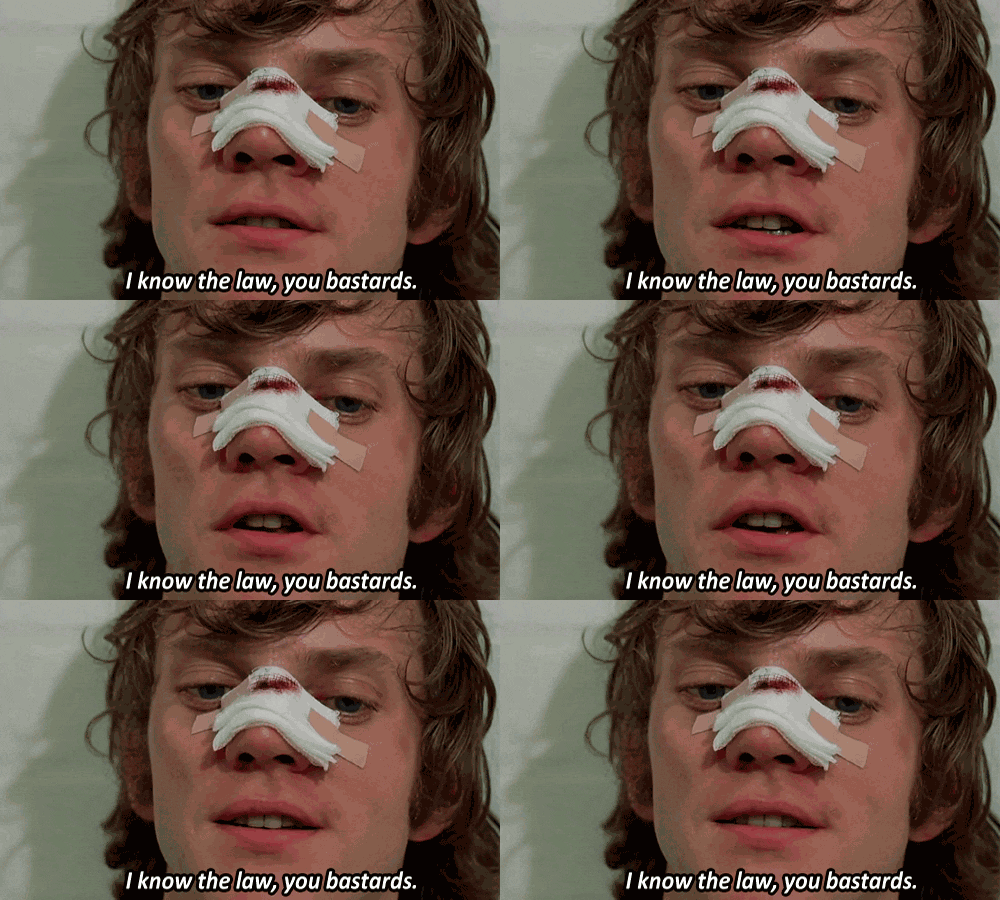
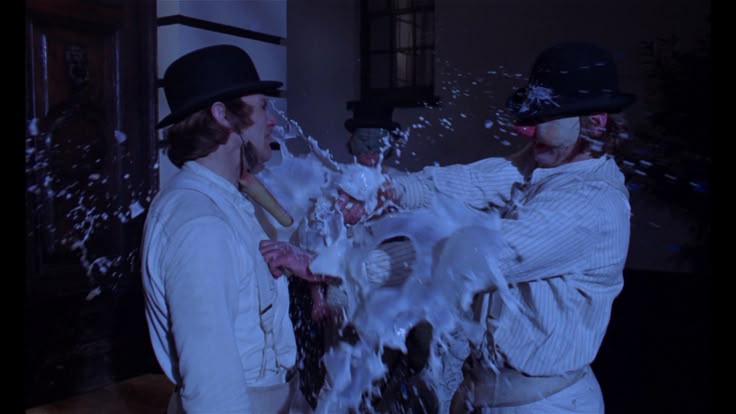
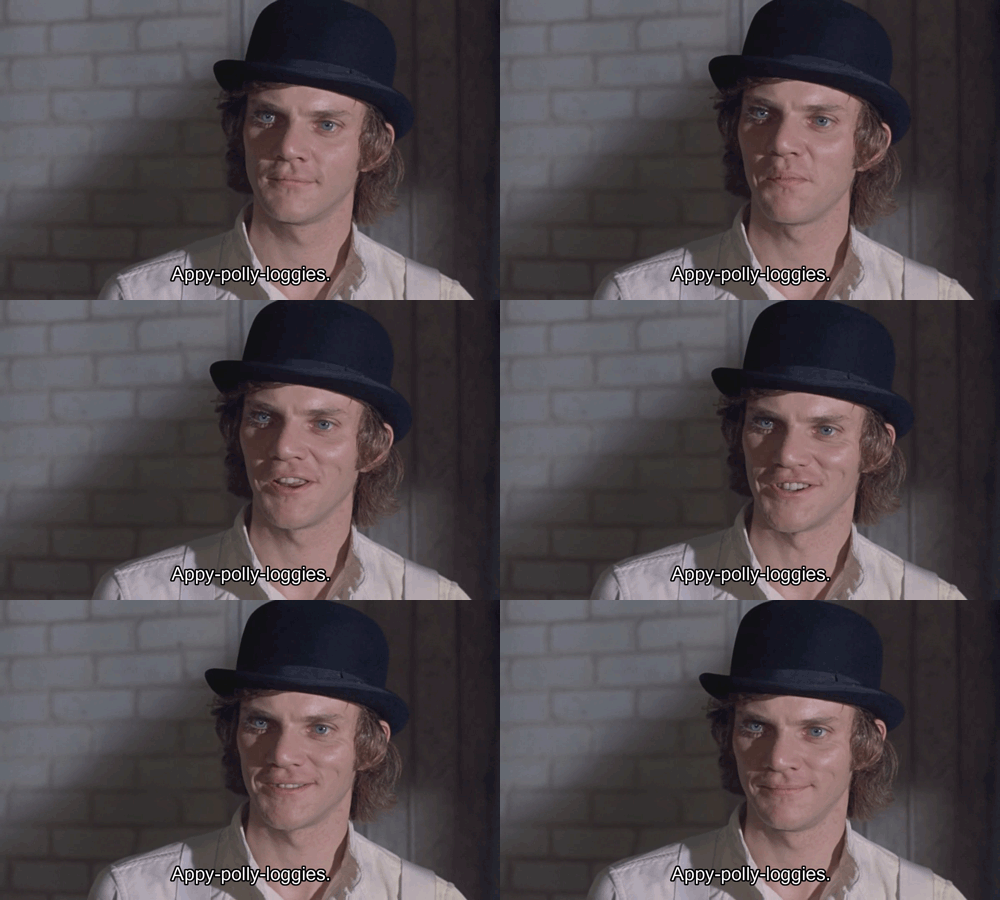
At the base of A Clockwork Orange, there is a question of morality. Whether or not what Alex does in the former half of the story, justifies the latter. After being sabotaged by his Droogs, (Friends in the fictional dialect, Nadsat) Alex is sentenced to 14 years in prison for murder and is referred to only by the number 6655321. Two years into his sentence, he asks the priest he had been interning for if he could be involved in a brand-new experimental treatment. As we will come to discover, the treatment known as the Ludovico technique is made to rewire your brain, making you associate acts of violence with a horrible, debilitating sickness by subjecting you to violent films, unable to look away. This results in Alex's complete inability to commit violence, despite his enduring bloodlust. The Ludovico leaves Alex completely helpless to the whims of his former victims, and eventually to his former friends, who have now landed jobs in law enforcement. The contrast between the audience's instinct to punish Alex's actions, and the inhumanity of the psychological conditioning Alex endures, is meant deliberately to unsettle the viewer. Kubrick is quoted in an interview with Modern Times saying, "It was absolutely necessary to give weight to Alex's brutality, otherwise I think there would be moral confusion with respect to what the government does to him. If he were a lesser villain, then one could say: "Oh, yes, of course, he should not be given this psychological conditioning; it's all too horrible, and he really wasn't that bad after all." On the other hand, when you have shown him committing such atrocious acts, and you still realize the immense evil on the part of the government in turning him into something less than human in order to make him good, then I think the essential moral idea of the book is clear. It is necessary for man to have choice to be good or evil, even if he chooses evil. To deprive him of this choice is to make him something less than human - a clockwork orange." In other words, the violence in the book, and subsequentially the movie, is instrumental to the themes the movie presents. It would be easy to justify criticizing the government's actions if Alex was innocent, but making his actions horrific and inexcusable forces the audience to empathize with the inhumane. This distinction is necessary because this is the kind of question asked in our reality. It would be hypocritical for us to justify what is done to Alex because of his own wrongs, if we would just as easily call the punishment barbaric and cruel if Alex were innocent.
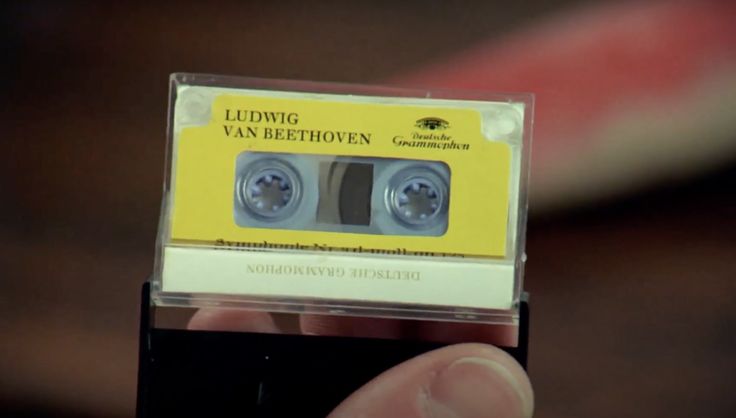
The reason the Ludovico treatment is so horrific is because it deprives you of the human will. The ability to make one's own choices, to decide between doing right or doing wrong, is a necessary freedom. This is pointed out directly during the middle of the story, when the priest says to the crowd of politicians, "He ceases the be a wrongdoer, he ceases also to be a creature capable of moral choice!" In my interpretation, Alex Delarge seems to be a stand-in for human will. The book and movie both lead us to the conclusion that it is better to be free, and evil, than to be good solely because you have no choice but to be. This is again clear when in an interview, Kubrick states that, "I think, in addition to the personal qualities I mentioned, there is the basic psychological, unconscious identification with Alex. If you look at the story not on the social and moral level, but on the psychological dream content level, you can regard Alex as a creature of the id. He is within all of us. In most cases, this recognition seems to bring a kind of empathy from the audience, but it makes some people very angry and uncomfortable." In psychoanalytic theory, the id is described as the part of the mind in which innate instinctive impulses and primary processes are manifest. I would argue that this encompasses both our immoral and moral instincts, and that the Ludovico actively limits both sides of moral choice. Alex is just as repulsed by his want to enact violence as his need for self-defense. Alex's love for Beethoven, arguably the worldliest aspect of his personality, is also taken from him because of the Ludovico. Our deep-rooted desire to make our own choices far outweighs being forced to always make the right ones.
In an interview, when asked how he sees his film, Kubrick says that "The central idea of the film has to do with the question of free-will. Do we lose our humanity if we are deprived of the choice between good and evil? Do we become, as the title suggests, A Clockwork Orange? Recent experiments in conditioning and mind control on volunteer prisoners in America have taken this question out of the realm of science-fiction." While Kubrick is referring to the more blatant examples of psychological conditioning happening at the time of this interview (~1980), The same kind of threat to free will is relevant today. With the expansion of the manipulative online algorithm, blatant propaganda produced by our own government, and the rampant ai-driven data collection used for targeted advertisements, it is easy to see how often our free will is narrowed by our limited information, making it nearly impossible to make a reasoned, deliberate choice.
The way A Clockwork Orange tackles complicated concepts is the reason I find it so comforting. When you take your current situation, and look at it through the lense of the fantastical or surreal, it allows you to gain a new perspective, and see your condition more objectively. By framing the moral dilemma of A Clockwork Orange with dreamlike cinematography, horror-satire, and charming wit, it makes for an objectively beautiful movie. I find an odd comfort in the surreal, especially when covering very real issues.
I like watching A Clockwork Orange because its way of framing complex real-life issues in a surreal setting allows me to think objectively and rationally. Disconnecting yourself from an active threat by implementing them in fiction allows us to view the moral dilemmas and injustices we face today gives us a perspective we otherwise wouldn't have been able to see.